Decision intelligence for operational disruptions — simulate options, explain choices, approve action.
OpsTwin is a decision-intelligence platform for operations teams facing live disruptions. It builds a connected model of your operation, simulates the impact of every response strategy, and surfaces a clear, explainable recommendation — ready for your team to review and approve. Nothing is actioned automatically.
Not a replacement for operational judgement. Verify recommendations and follow your organisation's procedures.
Why OpsTwin
Clear decisions under pressure — with a full explanation and audit trail.
Built for operations teams that handle live disruptions, OpsTwin brings structure to the decisions that matter most — without replacing the people who make them.
Connected operational model
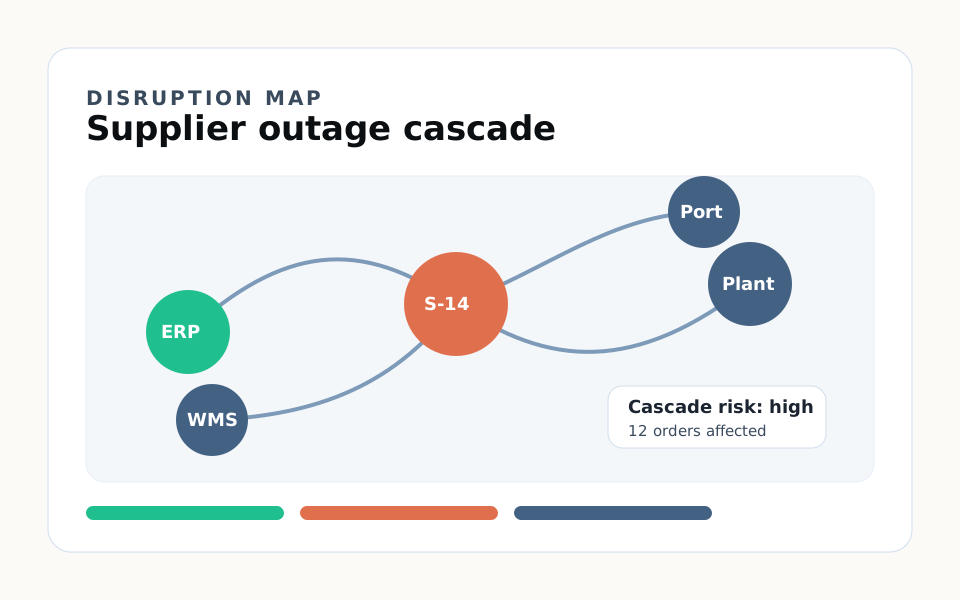
Maps your assets, processes, suppliers, routes, and inventory into a live, connected model that updates as your operation evolves.
Disruption scenario simulation
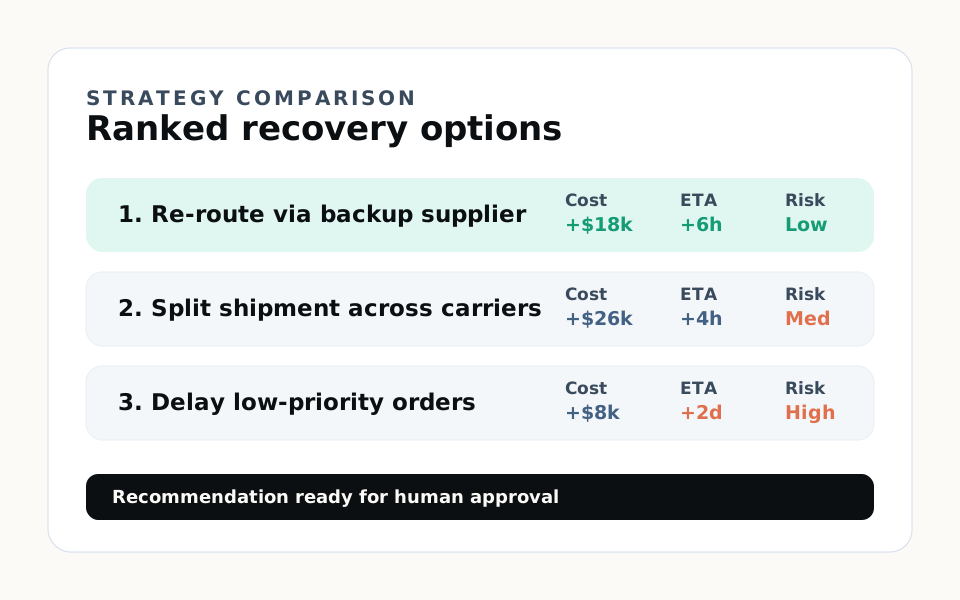
For every disruption, OpsTwin simulates multiple response strategies and estimates the impact on cost, delivery, quality, and risk — automatically.
Explainable recommendations
Every recommendation comes with a plain-language explanation — the key assumptions made, the trade-offs involved, and where the main uncertainty lies.
Human-first approval
No action is taken automatically. Recommendations are routed to the right approver with a full decision brief. Your team decides. OpsTwin records everything.
How it works
From disruption to approved decision — in minutes, not hours.
OpsTwin runs the same structured process every time — so your team spends time deciding, not reconstructing what happened.
1. Map your operation
During onboarding, we map your key assets, processes, suppliers, routes, and inventory into a connected operational model — refined as you go.
2. Detect the disruption
OpsTwin picks up disruption signals from connected systems or manual input, identifies what is affected, and maps the cascade risk immediately.
3. Simulate strategies
Multiple response options are simulated automatically against your operational model. Cost, delivery, quality, and risk impact quantified per option.
4. Compare and explain
Results are presented side by side with a plain-language explanation of the top recommendation — assumptions, trade-offs, and key uncertainties included.
5. Approve and act
The recommendation is routed to the right approver with a full briefing. They review, approve, or modify. Nothing happens automatically.
6. Learn from outcome
After implementation, OpsTwin tracks what actually happened versus what was predicted — improving future recommendations over time.
“When a supplier went down, we had three options modelled and ranked before our planning call even started. That is what changed.”
Supply Chain Director
Manufacturing pilot
“The explanation told us why the recommendation was made and what it assumed. That is what made us confident enough to approve it.”
Plant Manager
Process industry pilot
“We had the full audit record of every disruption response in one place. For compliance, that alone was worth the pilot.”
Operations Lead
Logistics pilot
Use cases
Old workflow → operational decision intelligence
OpsTwin is the decision layer for operations teams — connecting your existing systems, modelling disruptions, and turning time pressure into clear choices.
Supply chain
Disruption-aware supply decisions — with ranked options
Old workflow: Planners manually assess impact across siloed ERP, email, and spreadsheets. Response is whoever has the most context in the room.
Agentic opportunity: Disruption detected. Scenarios simulated. Ranked recovery options — with cost and delivery impact — ready for the planning lead to approve in minutes.
Manufacturing
Equipment failure → schedule recovery, not firefighting
Old workflow: Plant manager calls the team. Impact assessed informally. Recovery plan built from experience and gut feel.
Agentic opportunity: Asset failure mapped. Production orders at risk identified. Recovery strategies simulated with cost and schedule impact before the response meeting starts.
Cement and process plants
Process deviations → quality risk understood instantly
Old workflow: Engineers track kiln temperature and quality deviations manually. Impact on downstream product is estimated from experience.
Agentic opportunity: Deviation detected. Quality impact traced through the process model. Continue, adjust, or halt — with evidence — put to the plant manager for decision.
Logistics and freight
Route disruption → re-planned, costed, and approved
Old workflow: Freight managers re-plan manually through carrier portals, calls, and spreadsheets under time pressure.
Agentic opportunity: Route disruption detected. Alternate options simulated with cost and transit time. Booking instruction generated. Awaiting logistics lead approval.
City and infrastructure
Service disruption → staged response, not reactive calls
Old workflow: Cross-department coordination by phone during incidents. Impact on dependent services identified slowly and informally.
Agentic opportunity: Disruption mapped across interdependent services. Staged response plan generated with crew deployment sequence and communication guidance.
FAQ
Answers for operations and IT teams.
Does OpsTwin replace our ERP, MES, or planning systems?
No. OpsTwin sits alongside your existing systems as a decision layer. It reads from them and routes approved recommendations back — it does not replace, duplicate, or compete with your operational tools.
Do you need live system connections to start a pilot?
No. A pilot can begin with exported data or manual input. Live system connections are added progressively as the engagement matures. Most organisations start with a spreadsheet export from one system.
Does OpsTwin take actions automatically?
No. Every recommendation requires human review and approval before anything is actioned. OpsTwin surfaces the decision — your team makes it. The audit record of every decision is always available.
How long does a pilot take?
A feasibility prototype — one scenario, one domain, your real data — typically takes 2 to 4 weeks. A data-connected pilot with live integration runs over 6 to 8 weeks. We agree the scope before we start.
Ready for decision intelligence that explains itself?
Start a pilot or talk with our team about your operational environment.